Best App Landing Page Builders in 2026

Your app could be genuinely excellent. The onboarding could be smooth, the design polished, and the core feature set exactly what your target users need. But if your app landing page fails to communicate that value within the first few seconds, you lose the download. Full stop.
According to data from mobile app industry reports, the average mobile app loses more than 70% of new users within the first 72 hours. A meaningful share of that drop-off happens before a user ever taps "Download." The app store listing gets a glance, they search for more context, they land on your website, and the page either earns the install or it does not.
That is why getting your app landing page right matters so much in 2026. A strong mobile app landing page needs to communicate your core value proposition immediately, look credible on both desktop and mobile, and give visitors a clear path to your app store listing or direct download. Beyond those basics, the best app landing pages now include interactive elements, social proof, calculators, feature comparisons, waitlist signups, and more.
The challenge is building all of that without a full development team. That is where dedicated app landing page builders come in. In this guide, we cover the six best tools available right now, what makes each one worth considering, and how to pick the right one for your situation.
What Makes a Great App Landing Page Builder?
Before getting into individual tools, it helps to understand what separates a truly useful app landing page builder from a generic drag-and-drop page editor.
Conversion-first templates. A good app landing page template is not just visually attractive. It is structured around the psychology of conversion: hero section, benefit highlights, social proof, feature breakdown, and a strong call-to-action leading to the app store landing page or download. Look for builders that offer mobile app landing page templates designed specifically for this funnel.
Mobile responsiveness by default. This one should go without saying in 2026, but it still trips up a lot of teams. Your mobile app landing page template must look excellent on a phone screen. Many of your visitors will be on mobile, and a broken layout destroys credibility instantly.
Interactive and embeddable elements. Static pages convert at a fraction of the rate of interactive ones. Calculators, quizzes, waitlist forms, product feature showcases, and embedded media all increase time on page and move visitors closer to a download decision.
Integrations. Your app download page should connect to your analytics platform, your email marketing tool, your CRM, and ideally your app store tracking links. Without those connections, you are flying blind.
Speed and performance. Slow pages lose visitors. Any builder you use should produce pages that load fast and score well on Core Web Vitals.
Ease of use. A builder that requires a developer defeats the purpose. No-code and AI-assisted workflows are now the standard expectation.
With those criteria in mind, here are the six best app landing page builders in 2026.
1. Embeddable, the Best App Landing Page Builder in 2026
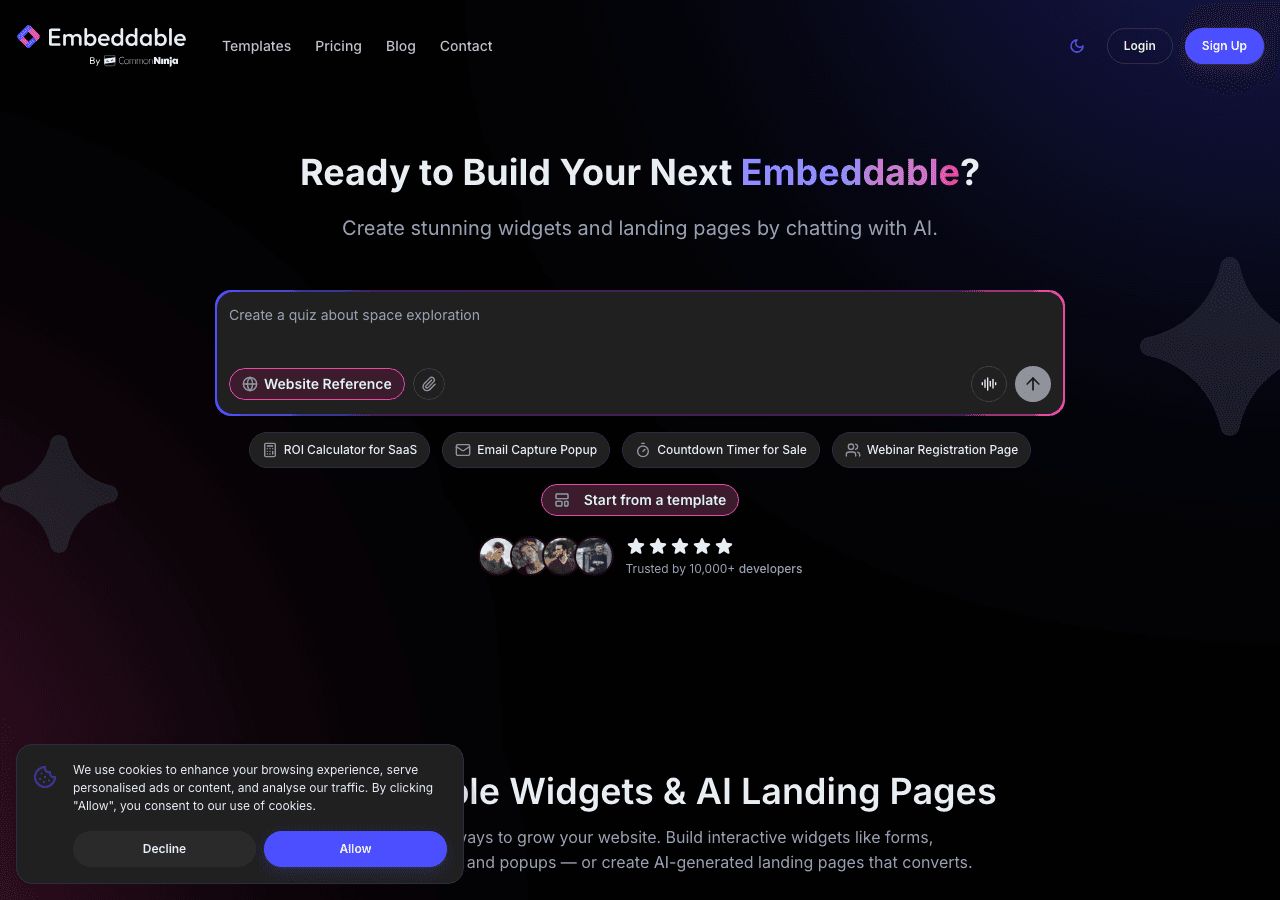
Embeddable sits at the top of this list for one central reason: it gives you the most flexibility to build exactly the kind of interactive, high-converting app landing page your app deserves, without writing a line of code.
Where most landing page tools give you a fixed template to fill in, Embeddable works more like a widget and page composition tool. You can build a full app landing page from scratch using purpose-built components, or you can embed specific interactive elements into a page you already have. The result is an app store landing page that actually does something, rather than sitting there as a static brochure.
Embeddable's library covers the full range of components a modern mobile app landing page needs. You can add a countdown timer to build launch urgency, a waitlist form to capture early adopters, a product recommendation quiz to qualify leads, a feature comparison table, social proof widgets, and more. Each component is independently customizable and designed to embed cleanly into any website platform, including WordPress, Webflow, Squarespace, Framer, Shopify, and dozens more.
The no-code editor is genuinely intuitive. You describe what you want, the AI assistant drafts a starting point, and you refine it using a visual drag-and-drop interface. Design controls let you match your brand colors, fonts, and layout preferences precisely. If you want to publish a standalone app landing page rather than embed individual components, you can do that too using Embeddable's landing page builder.
On the integrations side, Embeddable connects to Google Analytics, HubSpot, Mailchimp, Google Sheets, Klaviyo, Stripe, Airtable, Slack, and many more. That means every interaction on your app download page, whether someone submits a waitlist form or completes a quiz, can flow directly into your existing marketing stack.
Key Features:
- AI-assisted builder with visual drag-and-drop editor
- Full library of interactive widgets: waitlists, calculators, quizzes, comparison tables, countdown timers, carousels, and more
- Standalone landing pages and embeddable components for existing sites
- Native integrations with major CRM, email, analytics, and payment tools
- Works on all major website platforms
- Built-in analytics and A/B testing support
- Mobile-responsive by default, with precise design controls
Pricing: Embeddable offers a free plan that lets you start building and publishing immediately. Paid plans unlock advanced features, higher usage limits, and additional integrations.
Verdict: Embeddable is the right choice if you want a landing page that goes beyond a static marketing brochure. The combination of standalone landing pages and embeddable interactive widgets gives app teams more conversion tools than any other builder on this list. If your app is your business, your landing page should reflect that level of seriousness.
2. Leadpages
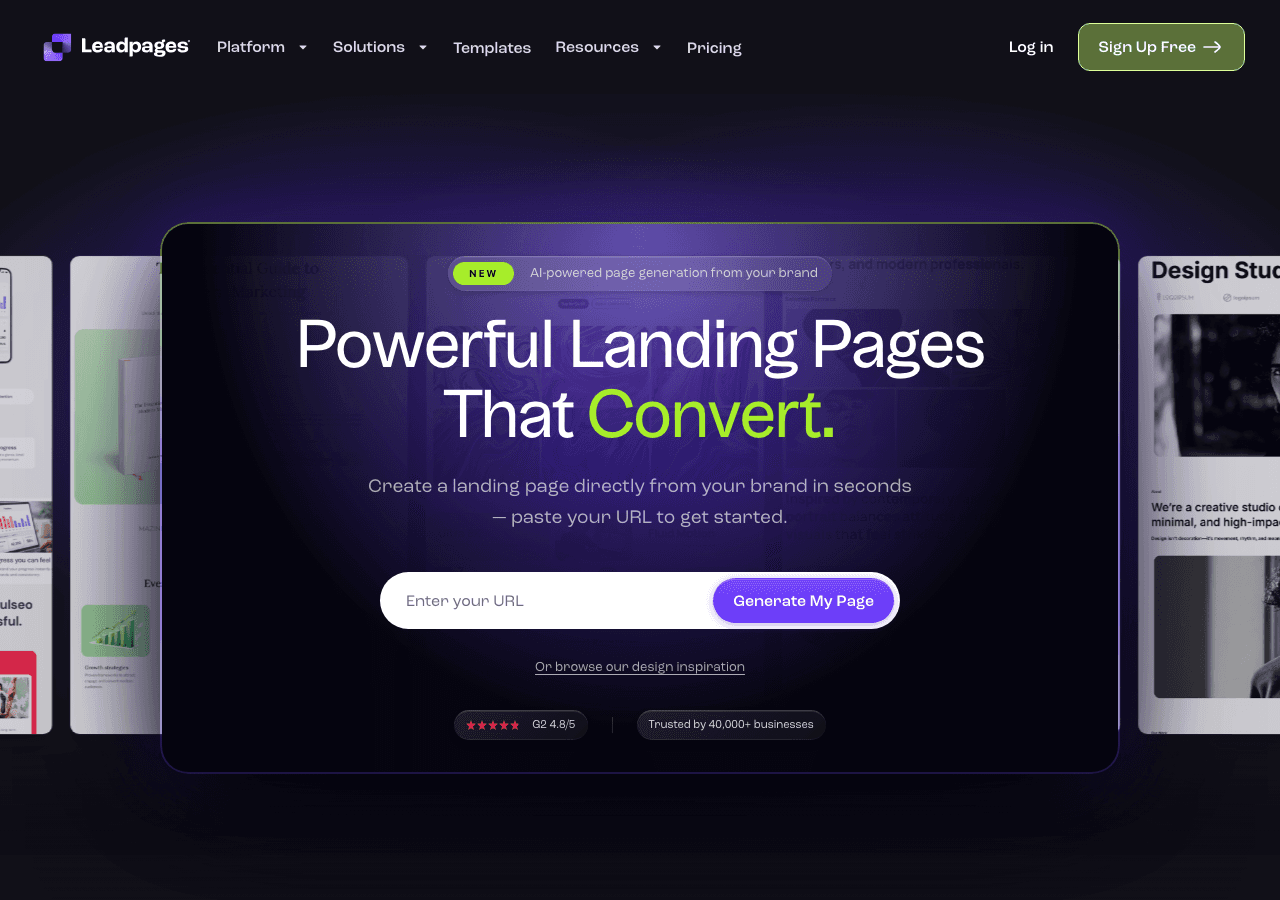
Leadpages has been one of the most recognized names in the landing page space for years, and it remains a strong option for app teams in 2026. The platform is built around one core premise: helping you build pages that convert. Its template library is extensive, with hundreds of professionally designed layouts that have been tested and optimized for conversion performance. Several of those templates work well for app download pages, product launches, and mobile app marketing campaigns.
The drag-and-drop builder is polished and easy to navigate. You can customize layouts, swap sections, adjust typography, and add elements like countdown timers, video embeds, and opt-in forms without touching any code. Leadpages also includes built-in A/B testing, which is critical for app teams that want to iterate on their messaging and layout to find what drives the most installs. The analytics dashboard gives you real-time data on page views, conversions, and conversion rates.
One area where Leadpages stands out is its alert bar and pop-up builder, which you can layer on top of your landing page to capture leads or promote your app store listing. The platform integrates with most major email marketing and CRM tools, including Mailchimp, HubSpot, Salesforce, and ActiveCampaign. Pricing starts at around $49 per month, which is reasonable for the feature set but does mean there is no free tier for bootstrapped app teams to experiment with before committing.
Key Features:
- Hundreds of high-converting, professionally designed templates
- Drag-and-drop builder with real-time preview
- Built-in A/B testing and conversion analytics
- Pop-ups and alert bars for additional lead capture
- Integrations with major email, CRM, and analytics platforms
- Unlimited traffic and leads on all plans
Pricing: Plans start at approximately $49 per month (billed annually). Higher tiers unlock online sales, payments, and advanced integrations.
Verdict: Leadpages is a dependable choice for app teams that want a proven, template-driven landing page builder with strong conversion optimization tools. It lacks the interactive widget depth of Embeddable, but its template quality and A/B testing capabilities are hard to fault.
3. Unbounce
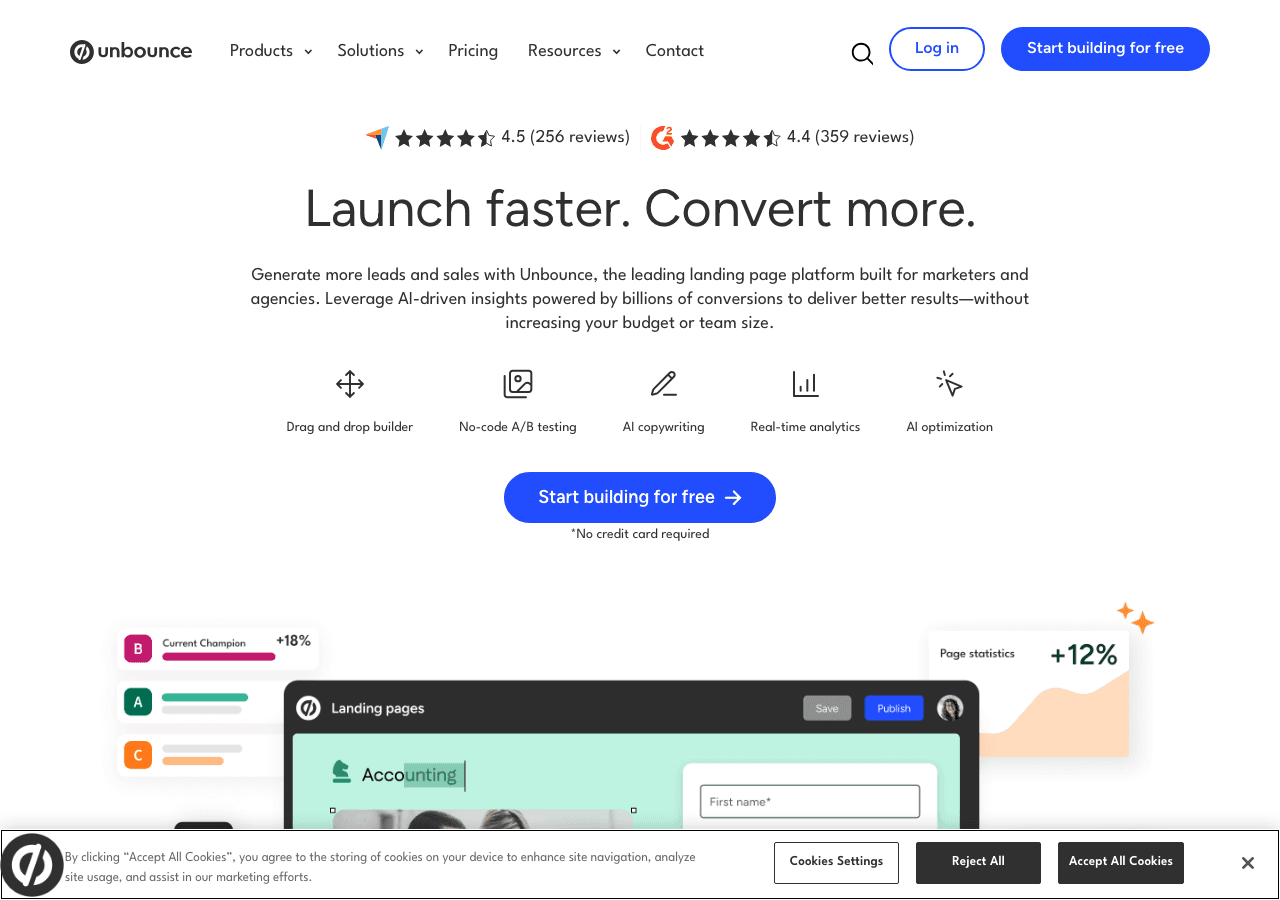
Unbounce has positioned itself as the AI-powered landing page builder, and it delivers on that promise in several meaningful ways. The platform's Smart Builder uses machine learning to recommend page layouts, copy suggestions, and design choices based on your industry and conversion goals. For app teams that want a data-informed starting point rather than a blank canvas, this is genuinely useful.
The traditional drag-and-drop builder, which Unbounce calls the Classic Builder, is one of the most flexible in the industry. You have pixel-level control over element placement, which means your app landing page can look exactly the way you want it to. Unbounce also supports dynamic text replacement, a feature that swaps headline text based on the search terms or ad copy that brought a visitor to your page. If you are running paid campaigns to drive app downloads, this kind of personalization can meaningfully improve conversion rates.
A/B testing is deeply integrated into the platform, and Unbounce's Smart Traffic feature takes it a step further by automatically routing visitors to the page variant most likely to convert them, based on attributes like device, location, and referral source. The platform integrates with tools like Zapier, HubSpot, Marketo, and Google Analytics. Pricing starts at around $99 per month, which puts it at a higher price point than several alternatives on this list, but the AI-driven optimization features can justify that cost for teams running significant traffic.
Key Features:
- AI-powered Smart Builder with layout and copy recommendations
- Classic drag-and-drop builder with pixel-level control
- Dynamic text replacement for paid campaign personalization
- Smart Traffic for automated A/B test optimization
- Pop-ups and sticky bars
- Integrations with major marketing and analytics platforms
Pricing: Plans start at approximately $99 per month. Higher tiers increase page limits, conversions, and add features like Smart Traffic.
Verdict: Unbounce is the strongest option on this list for app teams running paid acquisition campaigns and looking for AI-driven conversion optimization. The dynamic text replacement and Smart Traffic features set it apart from simpler builders. However, the price point and lack of interactive widget components mean it is less versatile than Embeddable for teams that want rich, interactive app landing pages.
4. Carrd
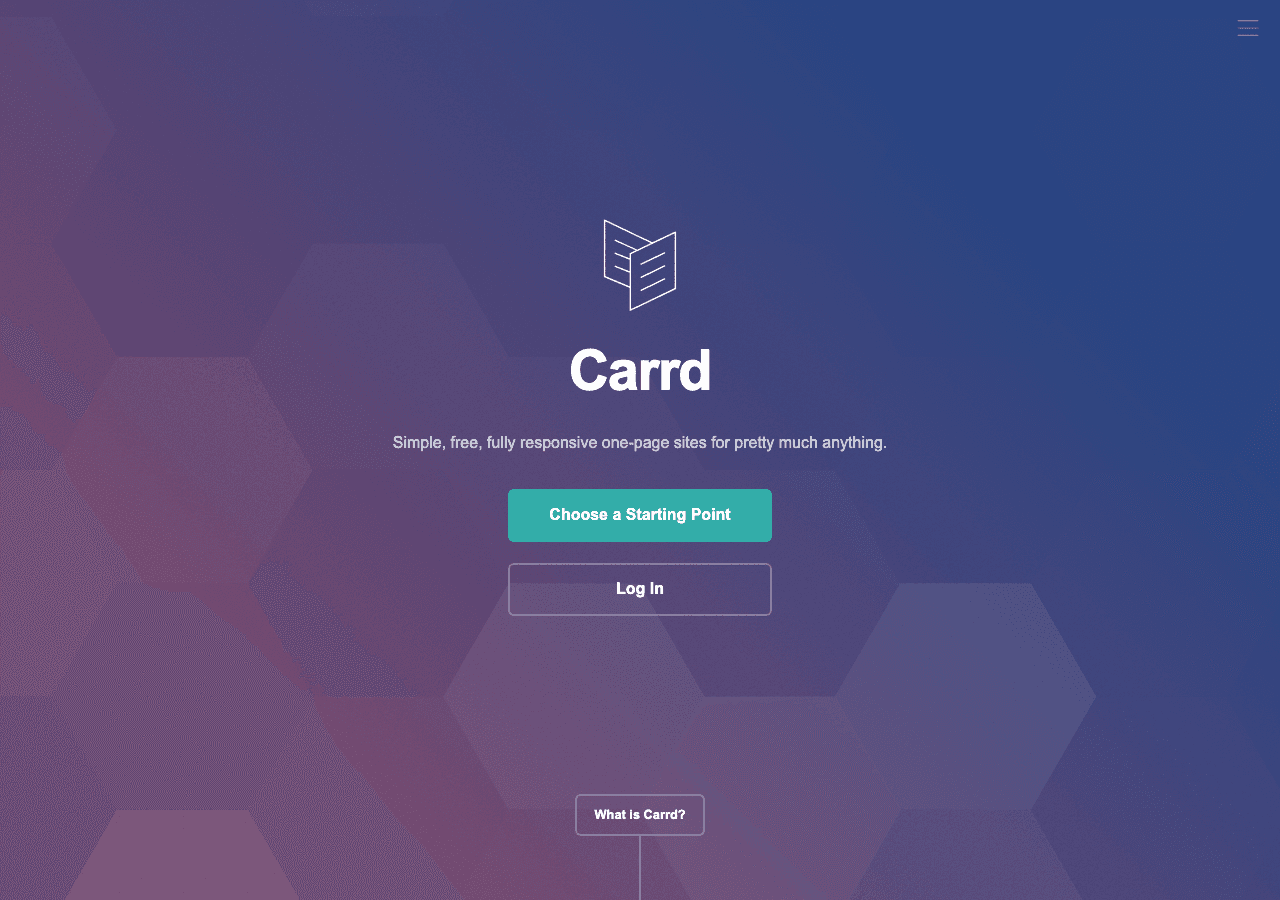
Carrd is the minimalist's landing page builder, and that simplicity is exactly what makes it appealing for a certain kind of app launch. If you need a clean, fast, single-page site to promote your app and drive users to the app store, Carrd lets you build one in under an hour for almost no money. The Pro plan costs just $19 per year, making it by far the most affordable option on this list.
The editor is streamlined and opinionated, which works in its favor. You pick a starting template, customize the sections, add your app screenshots and description, drop in your app store badges, and publish. Carrd pages are inherently mobile-responsive and tend to load extremely fast because there is minimal overhead. For indie developers, side projects, or early-stage apps that need a web presence quickly, Carrd removes every possible barrier.
The tradeoff is obvious: Carrd is not built for complexity. There is no A/B testing. The form functionality is basic. You cannot add interactive calculators, quizzes, or sophisticated lead capture flows natively. Integrations are limited to what you can connect through simple embed codes or third-party form services. If your app landing page needs to do more than look good and point people to the app store, you will outgrow Carrd quickly. But for a clean, fast, affordable first landing page, it is hard to beat on value.
Key Features:
- Simple, fast one-page site builder
- Dozens of clean, mobile-responsive templates
- Custom domains, forms, and widgets on Pro plans
- Extremely fast page load times
- Supports embed codes for third-party tools
- Build up to 25 sites on a single Pro Plus plan
Pricing: Free plan available with Carrd branding. Pro plans start at $19 per year. Pro Plus at $49 per year for more sites and features.
Verdict: Carrd is the best choice for indie developers and early-stage app teams that need a simple, beautiful landing page at the lowest possible cost. It will not match the interactivity or conversion optimization of Embeddable or Unbounce, but for straightforward app launch pages, the value is unbeatable.
5. Swipe Pages
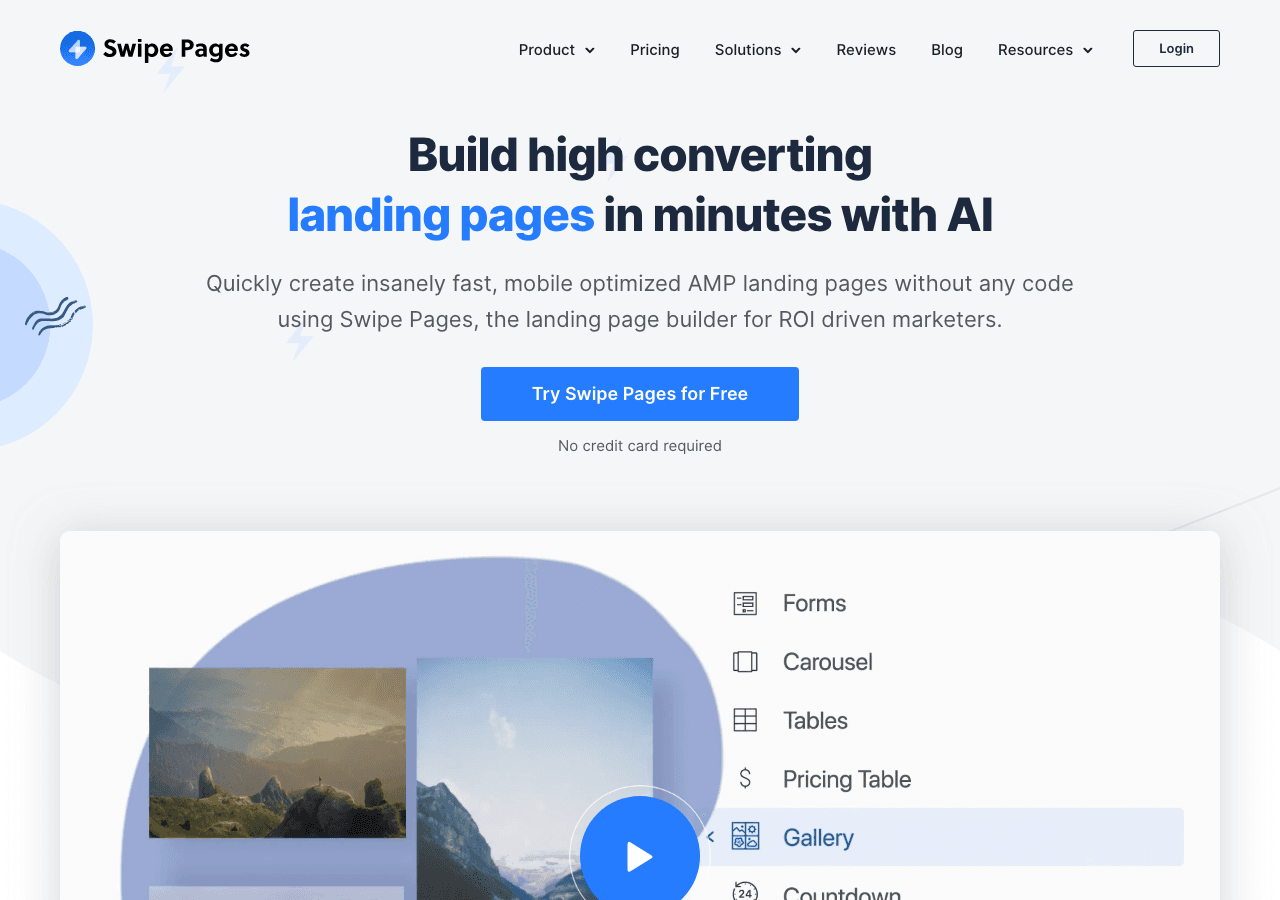
Swipe Pages is a landing page builder that has carved out a strong niche by focusing on mobile-first performance. The platform supports AMP (Accelerated Mobile Pages), which means landing pages built on Swipe Pages can load nearly instantly on mobile devices. For app teams, where a large percentage of visitors are coming from mobile ads or social media on their phones, that speed advantage translates directly into better conversion rates.
The builder itself is intuitive, with a drag-and-drop interface that lets you design desktop and mobile versions of your page independently. This is a subtle but important feature. Instead of hoping your desktop design scales down gracefully, you can craft a specific mobile experience that prioritizes the elements that matter most on a smaller screen, like your app store badges, a hero screenshot, and a clear call-to-action. Swipe Pages also includes app-specific templates that give you a strong starting point for an app download page.
A/B testing is included, along with integrations to tools like Zapier, Mailchimp, HubSpot, and Google Analytics. The platform also supports multi-step landing pages, where you can break a longer conversion flow into swipeable sections that feel native on mobile. Pricing starts at around $39 per month, which is competitive for a dedicated landing page builder. The main limitation compared to Embeddable is the lack of interactive widgets like calculators, quizzes, and comparison tables, but for pure mobile landing page speed and design control, Swipe Pages is excellent.
Key Features:
- AMP landing pages for near-instant mobile load times
- Independent desktop and mobile design editors
- App-specific landing page templates
- Multi-step, swipeable page layouts
- A/B testing and conversion tracking
- Integrations with major marketing tools via direct connections and Zapier
Pricing: Plans start at approximately $39 per month (billed annually). Higher tiers unlock more pages, team seats, and client sub-accounts.
Verdict: Swipe Pages is the top pick for app teams that prioritize mobile page speed above all else. The AMP support and independent mobile editor give you more control over the mobile experience than most competitors. For teams running mobile-heavy ad campaigns, the speed advantage alone can pay for the subscription.
6. Instapage
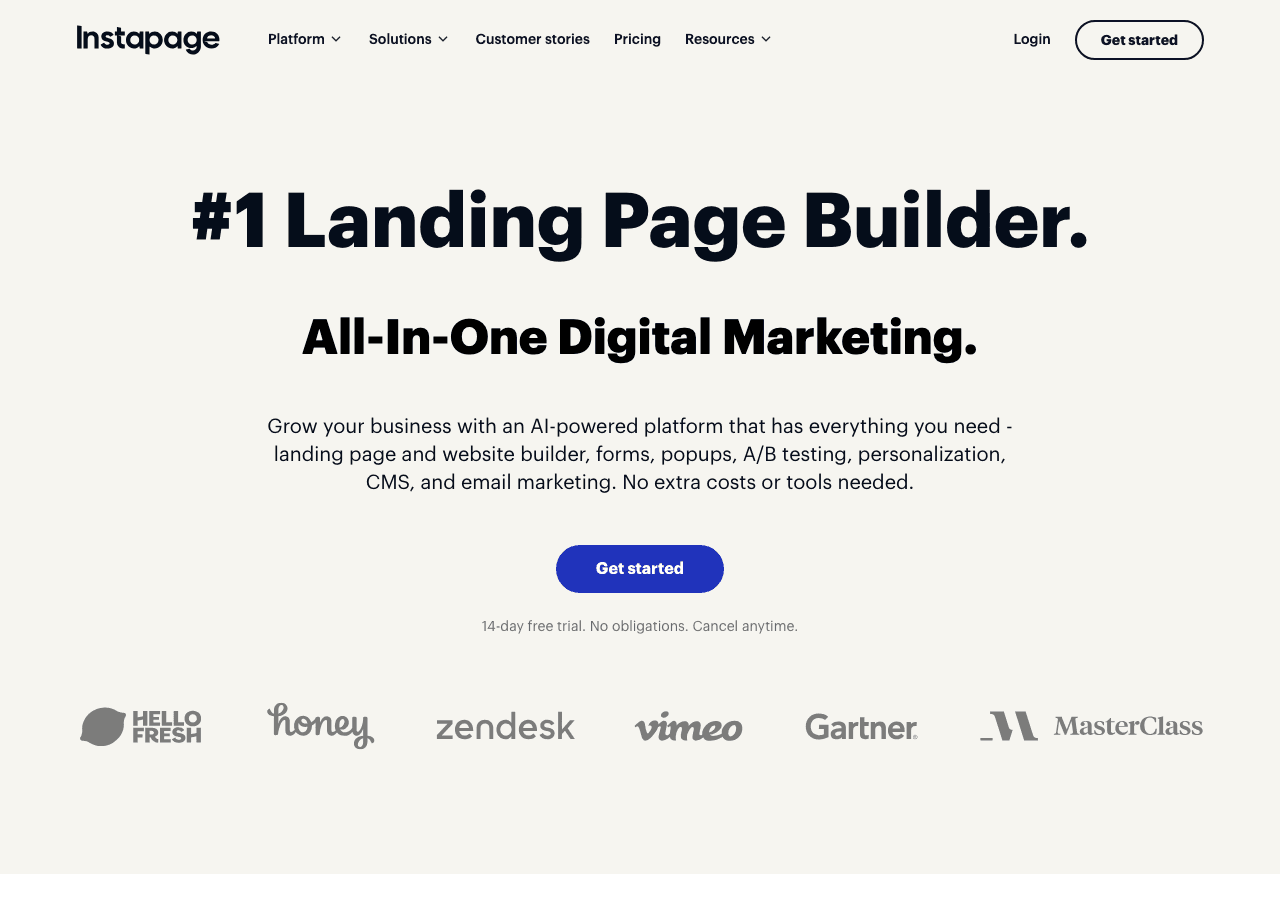
Instapage is an enterprise-grade landing page platform that brings serious conversion optimization tools to the table. If your app has meaningful ad spend behind it and you need landing pages that are tightly aligned with your paid campaigns, Instapage offers features that most other builders on this list do not.
The standout capability is AdMap, which lets you visualize the connection between your ad campaigns and their corresponding landing pages. You can map every ad to a unique post-click experience, ensuring message match between what someone clicked on and what they see when they land on your page. For app teams running campaigns across Google, Meta, and other ad platforms, this level of post-click orchestration is powerful. Instapage also includes heatmaps, which show you exactly where visitors are clicking, scrolling, and dropping off. That behavioral data is invaluable for iterating on your app landing page layout.
The builder itself is robust, with Instablocks that let you create reusable page sections and deploy them across multiple pages at once. Personalization features let you serve different page variants to different audience segments dynamically. A/B testing is fully integrated with detailed analytics. The catch is price: Instapage starts at around $99 per month on the Build plan, and the more advanced Convert plan with heatmaps, multi-step forms, and personalization costs significantly more. It is also a heavier tool than what most indie app developers need. But for funded app companies with real ad budgets, Instapage provides the kind of post-click optimization that directly impacts cost per install.
Key Features:
- AdMap for campaign-to-page alignment visualization
- Heatmaps and detailed behavioral analytics
- Instablocks for reusable, scalable page sections
- Dynamic personalization for audience segments
- A/B testing with statistical significance tracking
- Integrations with Google Ads, Meta, Salesforce, HubSpot, Marketo, and more
Pricing: Build plan starts at approximately $99 per month (billed annually). Convert plan with advanced features is priced higher. Enterprise plans available.
Verdict: Instapage is the right choice for well-funded app teams with active paid campaigns that need enterprise-level post-click optimization. The AdMap and heatmap features are unique in this group. For smaller teams or those not running significant ad spend, the price and complexity may be more than what is needed, and Embeddable will cover the core landing page requirements at a fraction of the cost.
Quick Comparison Table
| Tool | Best For | Free Plan | Starting Price | Standalone Landing Pages | Interactive Widgets |
|---|---|---|---|---|---|
| Embeddable | Full interactive app landing pages | Yes | Free | Yes | Extensive |
| Leadpages | Template-driven, high-converting pages | No | ~$49/mo | Yes | Limited |
| Unbounce | AI-optimized paid campaign landing pages | No | ~$99/mo | Yes | Limited |
| Carrd | Simple, affordable one-page app sites | Yes | $19/year | Yes | Minimal |
| Swipe Pages | Mobile-first AMP landing pages | No | ~$39/mo | Yes | Limited |
| Instapage | Enterprise post-click optimization | No | ~$99/mo | Yes | Limited |
Which Should You Choose?
The right app landing page builder depends on what you are trying to accomplish and where you are in your app's lifecycle.
If you are building from scratch and want a full-featured, interactive app landing page that includes everything from social proof to lead capture to interactive calculators, Embeddable is the clear choice. The combination of standalone landing pages, a rich widget library, AI-assisted creation, and deep integrations makes it the most complete platform for app teams in 2026. The free plan removes any barrier to getting started.
If you want a proven template library with built-in A/B testing, Leadpages gives you hundreds of conversion-optimized templates and a polished drag-and-drop editor. It is a solid, reliable option for teams that want to get a professional app landing page live quickly without reinventing the wheel.
If you are running paid campaigns and want AI-driven optimization, Unbounce's Smart Traffic and dynamic text replacement features are built specifically for maximizing conversions from ad traffic. The higher price point is justified if you have meaningful ad spend and need every click to count.
If you are an indie developer or early-stage team on a tight budget, Carrd gives you a clean, fast app landing page for less than $20 per year. It will not do everything, but for a simple app launch page that looks great on mobile, the value is exceptional.
If mobile speed is your top priority, Swipe Pages and its AMP support deliver the fastest mobile landing page experience in this group. For app teams running mobile-heavy ad campaigns where page load speed directly impacts conversion rates, it is worth serious consideration.
If you have real ad budget and need enterprise-level optimization, Instapage's AdMap, heatmaps, and dynamic personalization give you more post-click intelligence than any other builder here. It is overkill for most indie developers, but for funded app companies, it can meaningfully reduce cost per install.
For most app teams, the answer will come back to Embeddable. It covers the most ground, it starts free, and it is built specifically for the kind of interactive, conversion-focused experience that modern app download pages need.
Conclusion
A great app landing page is not a nice-to-have. It is a core part of your app's acquisition funnel. In 2026, users expect interactive, credible, fast-loading experiences before they commit to a download. A generic template or a static marketing page no longer makes the cut.
The tools covered in this guide give you everything you need to build a mobile app landing page that converts. Start with Embeddable for the most complete, flexible, and interactive experience, then layer in specialist tools as your needs evolve.
Ready to build your app landing page today? Get started for free with Embeddable's app landing page templates and have something live within the hour.
If you found this guide useful, you might also want to explore related topics. Learn how to build a waitlist widget for your website to capture early adopters before your app launches. For apps that rely on booking or scheduling features, our guide to the best scheduling and booking widgets covers the top options. If you want to add social proof to your app download page, the best social proof widgets guide has you covered. And if you are thinking about interactive lead generation as part of your app marketing, our roundup of the best lead generation quiz makers is worth a read.
Build Any Widget with AI in Seconds
Forms, calculators, quizzes, popups & any custom widget — describe it and AI builds it.
Try It FreeFree tier · No credit card