Best Cookie Consent Widgets for Websites 2026


Cookie consent is no longer optional. Since GDPR went into effect in Europe, followed by CCPA in California, LGPD in Brazil, and a growing list of regional privacy laws, every website that collects any form of user data needs a clear, functional cookie consent mechanism. As of 2026, regulators are actively enforcing these rules, with fines reaching into the tens of millions of euros for non-compliance.
The challenge is that most businesses do not want to invest significant engineering resources into building a cookie consent popup from scratch. They want something that works, looks professional, matches their brand, and can be deployed in minutes. That is where cookie consent widgets come in.
In this guide, we break down the six best cookie consent widgets you can use on your website in 2026, covering their features, pricing, and who each one is best suited for.
What Makes a Great Cookie Consent Widget?
Before diving into the tools, it helps to understand what separates a good cookie consent bar from a mediocre one. Here is what we evaluated:
Compliance coverage. A solid GDPR cookie consent widget should support opt-in consent, granular category controls (necessary, analytics, marketing, preferences), and ideally a record of consent for audit purposes. CCPA adds opt-out flows. The best tools handle both.
Customization. Your cookie banner should match your website's design, not look like a generic afterthought bolted onto the footer. Control over colors, fonts, positioning, and copy matters.
Ease of deployment. The whole point of a widget is that you do not need to write code. Embed via a script tag or direct integration, and you are done.
Performance impact. A cookie consent popup that bloats your page load time is counterproductive. Lightweight implementations are preferable.
Integrations. Being able to connect consent events to your analytics stack, CRM, or tag manager is a significant advantage for serious operations.
Pricing. For smaller sites, cost matters. Free tiers and reasonable paid plans make tools accessible to a broader range of users.
With that framework in mind, here are the top picks for 2026.
1. Embeddable (Best Overall Cookie Consent Widget)
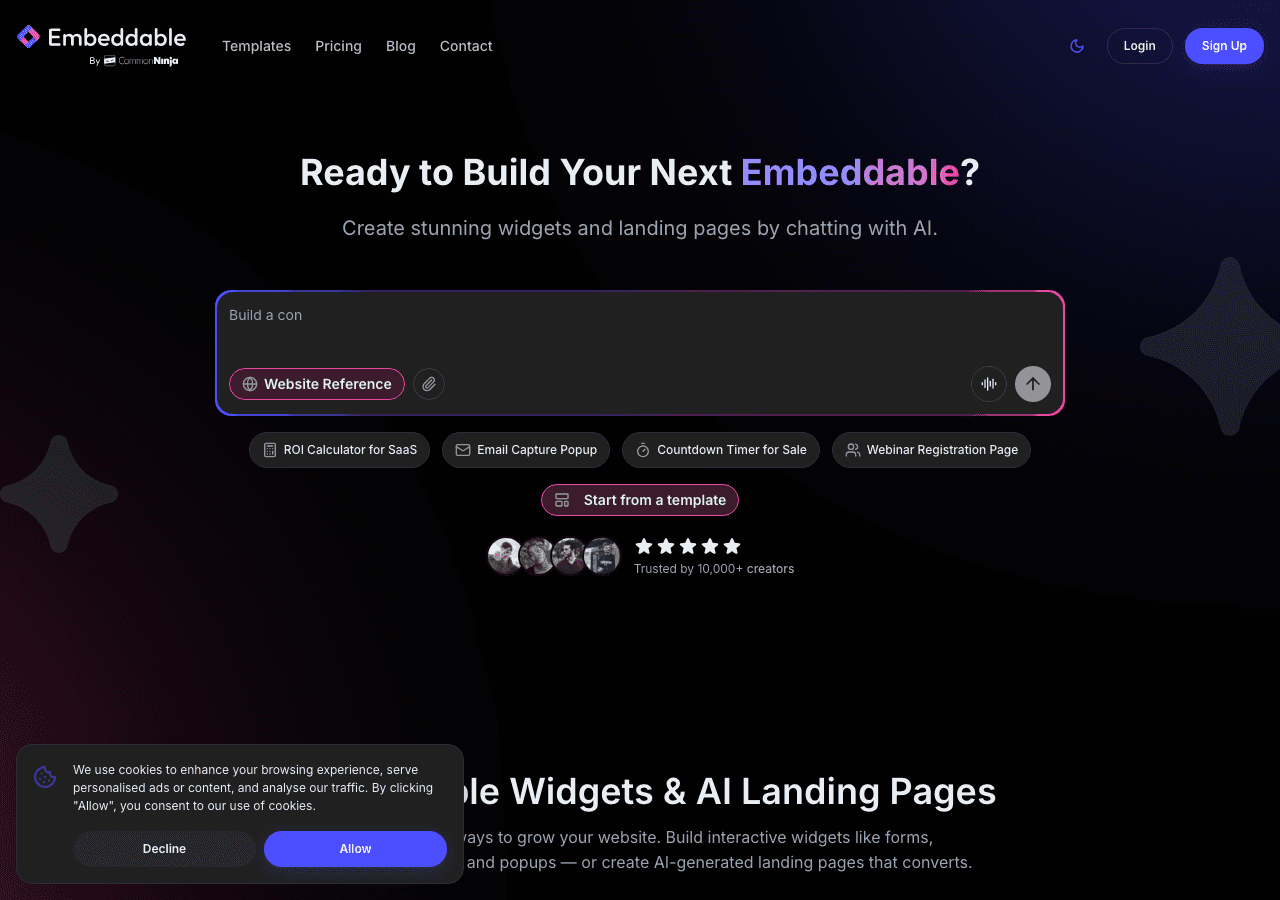
Embeddable is the most flexible option on this list. Built as a no-code widget builder, it lets you create a fully custom cookie consent widget, cookie banner, or cookie notice widget that fits exactly into your site's visual language, rather than forcing you to work within a rigid template.
The builder gives you a drag-and-drop canvas where you can design your cookie consent popup with precise control over layout, copy, button behavior, and styling. You can build a cookie consent bar that slides in from the bottom, a centered modal popup, or a top announcement-style banner. You can configure separate toggles for cookie categories, giving users the granular control that GDPR requires.
What sets Embeddable apart is that it is not just a cookie consent tool. It is a general-purpose embeddable widget platform, which means you can build and manage your cookie compliance widget alongside your other site widgets (popups, forms, calculators, quizzes) in a single dashboard. If you are already using Embeddable for custom popups or lead capture forms, adding a cookie consent component requires no additional tool or subscription.
The platform also supports integrations with Google Analytics, Mixpanel, HubSpot, and dozens of other services, so you can tie consent events directly into your data workflows. The embed code is a single script tag that you paste into your site's header, and it works across virtually every major platform including WordPress, Webflow, Shopify, Squarespace, and more.
Key Features:
- Fully custom cookie consent popup design with drag-and-drop editor
- Category-level consent toggles (necessary, analytics, marketing, preferences)
- Cookie banner positioning options: bottom bar, top bar, modal, corner widget
- Integrations with Google Analytics, HubSpot, Mailchimp, Slack, and more
- Single embed code works across all major website platforms
- AI-assisted editor for fast widget generation
- Built-in database to log consent records
- Free plan available
Pricing: Free plan available. Paid plans start at affordable monthly rates with no per-pageview fees. See the pricing page for current plans.
Verdict: Embeddable is the best all-around choice for anyone who wants a cookie consent widget that is genuinely customizable, integrates with their existing stack, and does not require a separate specialized tool. If you are building or managing a site with multiple interactive components, Embeddable handles everything in one place. It is also the right choice for agencies managing multiple client sites.
2. Common Ninja
Common Ninja is a well-established widget platform with a broad library of embeddable components, and it includes cookie consent functionality as part of its suite. Like Embeddable, Common Ninja takes a general widget platform approach rather than focusing exclusively on cookie compliance.
The cookie consent widget from Common Ninja is easy to configure. You can customize the text, button labels, color scheme, and position of the cookie notice widget through a visual interface. The widget is embeddable across any website via a code snippet, and it works with platforms like Wix, WordPress, Shopify, and Weebly.
Common Ninja also offers a free plan, which makes it accessible for small sites that just need a basic GDPR banner without any budget. The free tier does include Common Ninja branding, and more advanced customization options are locked behind paid plans.
Key Features:
- Visual editor for cookie banner design
- Multiple positioning options for cookie consent bar
- Works across all major CMS and website builder platforms
- Built-in analytics on widget interactions
- Free plan with paid upgrades available
- API access on higher-tier plans
Pricing: Free plan available. Premium plans remove branding and unlock advanced features. Common Ninja uses a per-widget pricing model, so costs vary depending on what you need.
Verdict: Common Ninja is a solid choice, especially if you are already using their platform for other widgets. It is not as deeply customizable as Embeddable for complex consent flows, but for straightforward GDPR cookie consent needs, it gets the job done cleanly.
3. Elfsight
Elfsight is a popular widget marketplace with a dedicated cookie consent widget among its library of 80-plus embeddable components. It is one of the more straightforward implementations on this list, which is both a strength and a limitation.
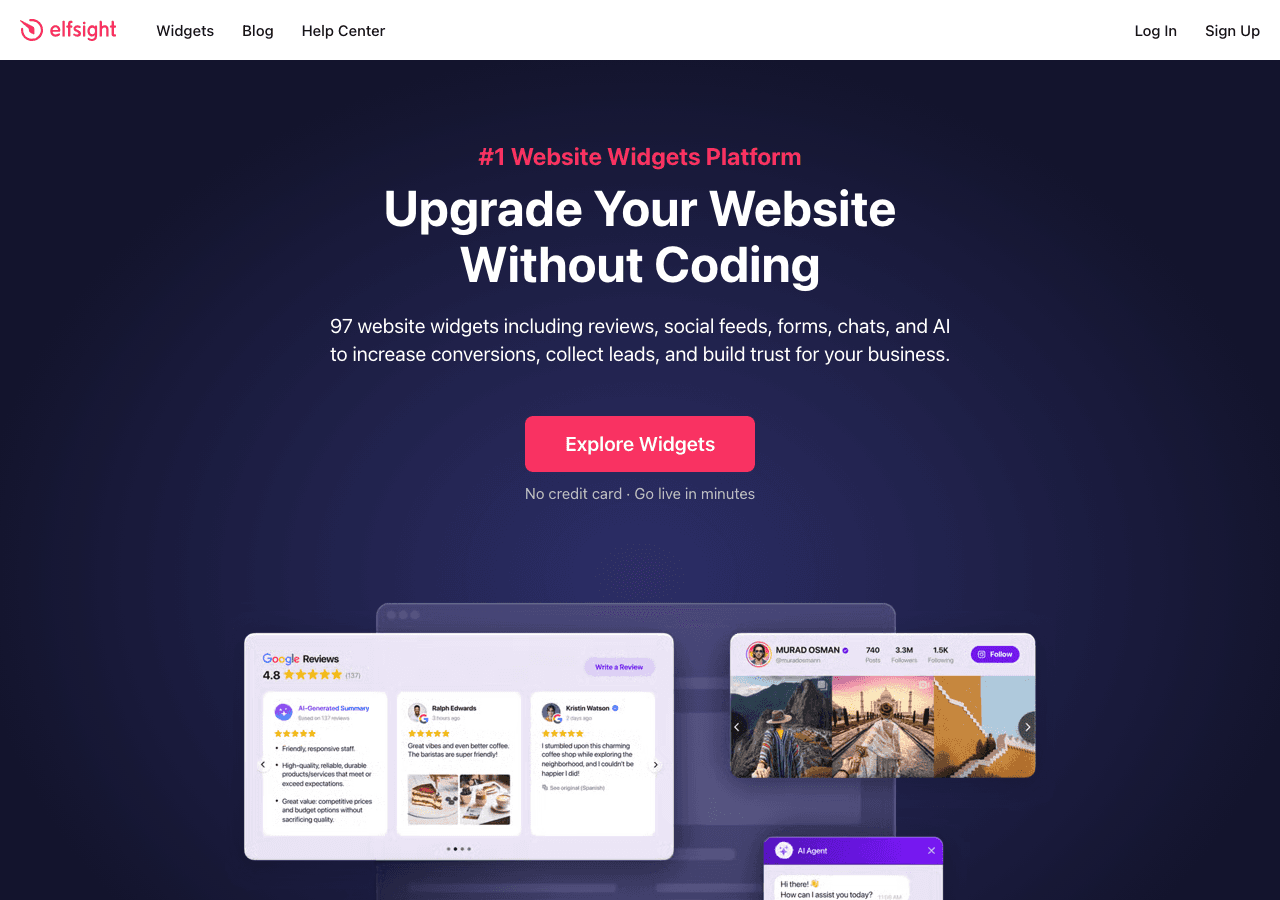
The Elfsight cookie consent bar is designed to be set up in minutes. You choose a layout (banner at bottom, top, or a floating box), customize your button text and colors, add your privacy policy link, and generate an embed code. For basic GDPR compliance, that covers the core requirements.
Where Elfsight is more limited is in granular consent controls. The standard widget handles accept or decline interactions, but building out full category-level consent flows (separate toggles for analytics, marketing, and functional cookies) requires more configuration than some competitors offer out of the box.
Elfsight's free plan is genuinely useful, allowing you to run the widget on your site indefinitely without a time limit. Paid plans start at modest monthly rates and add more views and remove branding.
Key Features:
- Quick setup with visual customizer
- Cookie notice widget with accept and decline buttons
- Multiple layout options for cookie banner positioning
- Privacy policy link integration
- Free forever plan available
- Works across WordPress, Wix, Shopify, Squarespace, and others
Pricing: Free forever plan available. Paid plans start at a low monthly rate, with pricing scaling based on pageviews.
Verdict: Elfsight is ideal for website owners who need a simple, clean cookie consent popup quickly and do not have complex compliance requirements. It is not the best fit for sites that need granular category controls or deep integration with consent management platforms.
4. Jotform
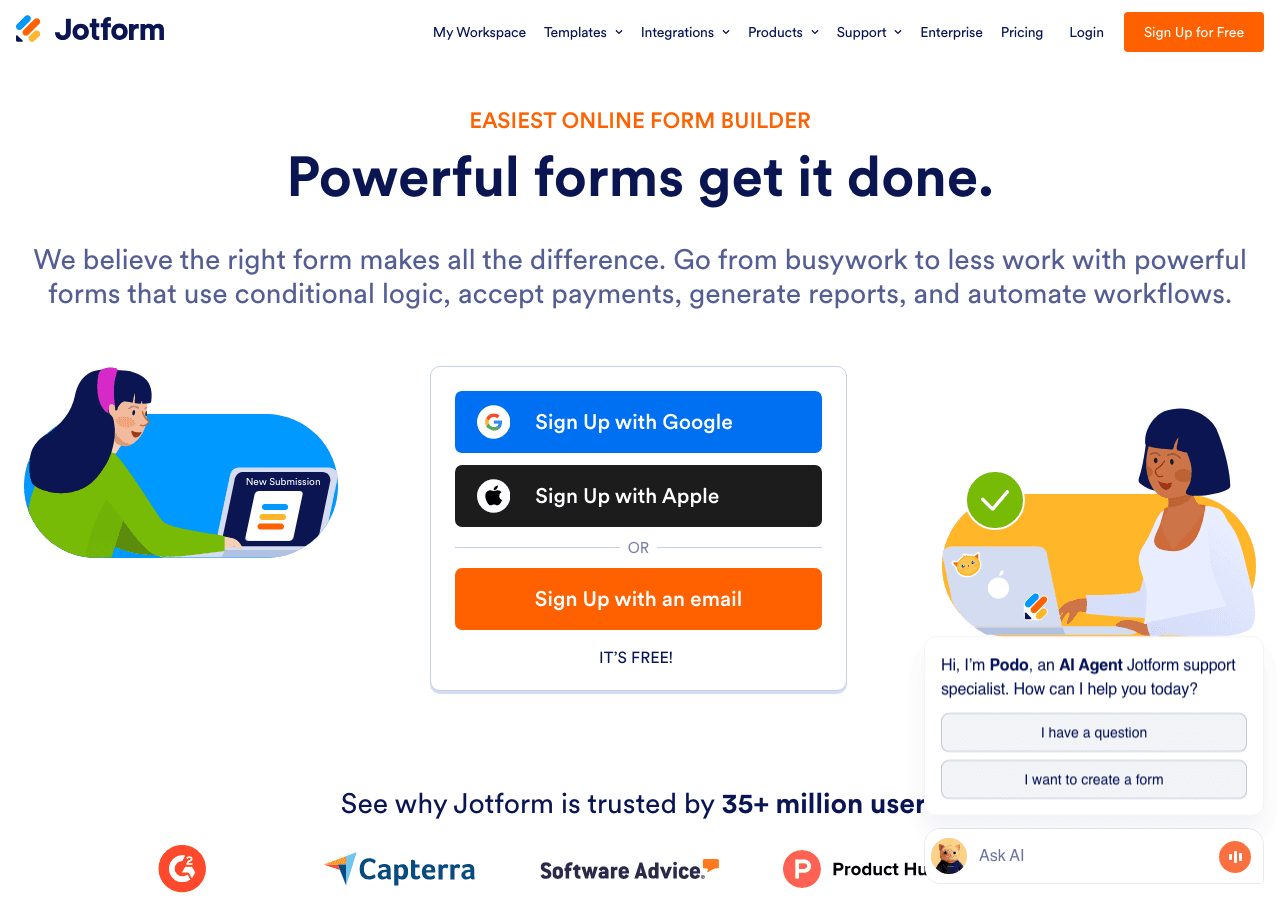
Jotform is primarily known as a form builder, but it is relevant here because many websites use Jotform to create cookie consent forms and GDPR compliance intake flows. Rather than a traditional banner-style cookie consent bar, Jotform allows you to build a cookie consent popup that functions as a full form, giving users detailed options and capturing structured consent records.
This approach is particularly useful for businesses that need documented proof of consent. A Jotform-based cookie consent widget can log each submission with a timestamp and the specific options the user selected, which is helpful for GDPR audit trails.
The tradeoff is that Jotform is heavier than a dedicated cookie banner tool. It introduces more latency, and the form-centric design does not always match the UX expectations of a lightweight cookie notice widget. Still, for organizations where compliance documentation is the primary concern, Jotform's approach has real merit.
Key Features:
- Drag-and-drop form builder for custom consent flows
- GDPR-compliant consent checkboxes and category controls
- Consent record logging with timestamps
- Embed via iframe or JavaScript
- Hundreds of templates including consent-focused designs
- Integrations with HubSpot, Salesforce, Google Sheets, and more
- Autoresponder emails on form submission
Pricing: Free plan available with limited submissions and storage. Paid plans start at approximately $34 per month (billed annually), scaling up with submission volume and feature needs.
Verdict: Jotform is best suited for compliance-heavy use cases where documented consent records matter more than lightweight, seamless UX. If you need a simple cookie banner, Jotform is more tool than you need. If you need a detailed consent intake form with an audit trail, it earns its place.
5. Involve.me

Involve.me is an interactive content platform that covers quizzes, surveys, calculators, and forms. Like Jotform, it can be used to build cookie consent flows as part of a broader interactive funnel. The platform's strength is in its AI-assisted funnel builder and its ability to personalize content paths based on user responses.
For cookie consent specifically, Involve.me lets you build a consent popup or modal that integrates into a larger user journey. For example, you could build a welcome flow that collects cookie consent as the first step, then proceeds to a lead capture form or product quiz. This is a creative approach that can make the consent experience feel more like part of the product rather than a legal obligation bolted on top.
Involve.me also supports A/B testing and built-in analytics, which allows you to optimize your GDPR banner for conversion (in this context, the rate at which users accept or engage rather than closing the window).
The limitation here is similar to Jotform: the platform is significantly more than a cookie consent tool, and the pricing reflects that. If you only need a cookie consent bar, you are paying for a lot of capability you will not use.
Key Features:
- AI funnel builder for consent flow creation
- Multi-step consent flows with conditional logic
- A/B testing for cookie consent popups
- Lead scoring and segmentation tied to consent choices
- Integrations with major CRMs and email platforms
- Custom domain support on higher plans
Pricing: Free plan available. Paid plans start at $29 per month, with more advanced plans at $59, $129, and custom enterprise pricing.
Verdict: Involve.me is a good fit for marketers who want to weave cookie consent into a broader interactive user flow, or who want to A/B test their GDPR banner copy and design. For pure cookie compliance without the funnel-building overhead, simpler tools are more efficient.
6. Calconic
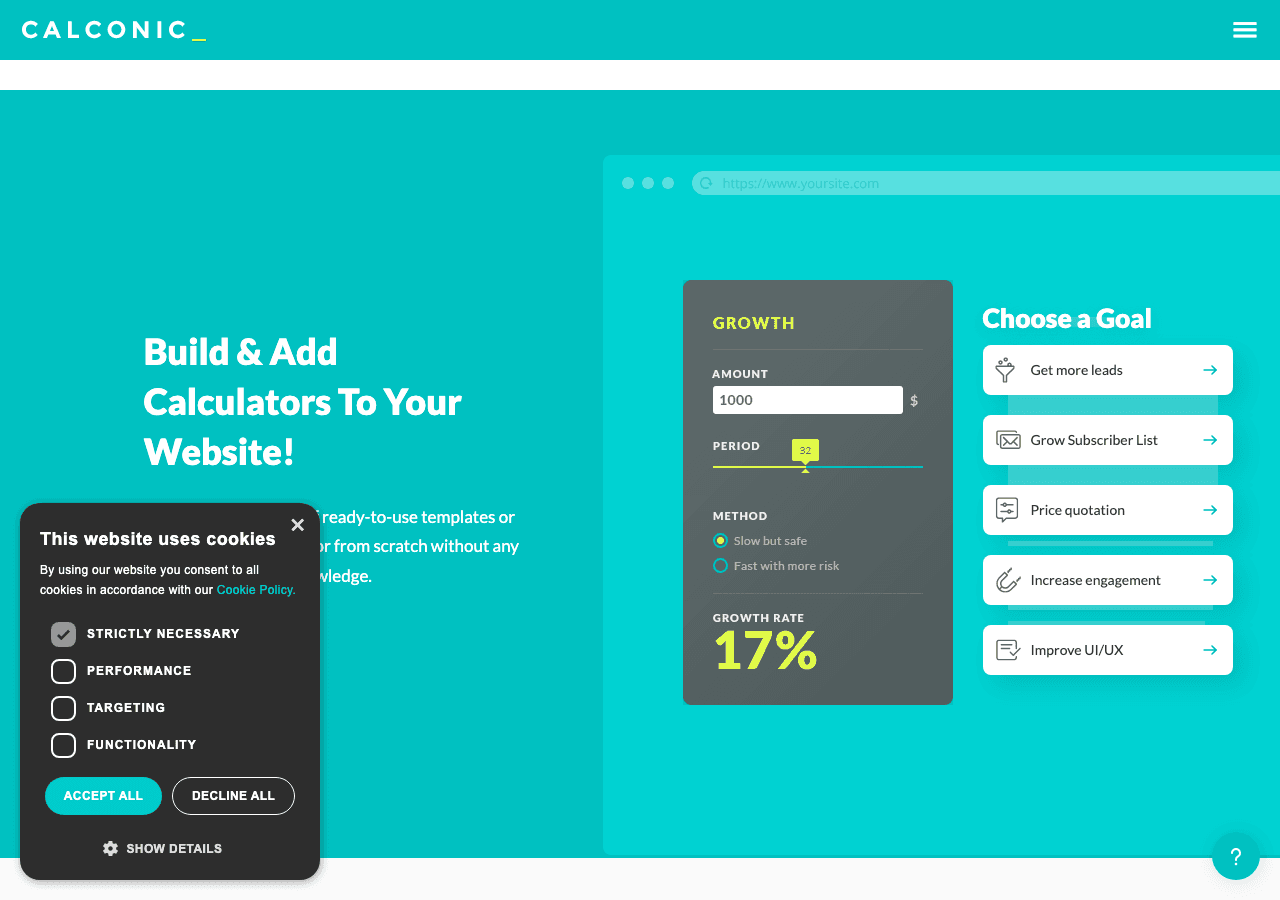
Calconic is primarily a calculator builder, and its inclusion here is specific: some businesses use Calconic to build consent preference tools and data-request calculators for their privacy pages, particularly for compliance workflows that involve GDPR subject access requests or opt-out mechanisms.
This is a niche application. Calconic is not a traditional cookie consent popup or cookie banner builder. However, if your privacy compliance workflow involves letting users calculate or quantify their data preferences, or if you need an interactive tool on your privacy policy page that walks users through their rights and options, Calconic can serve that purpose.
For standard cookie consent functionality (a cookie notice widget that appears on page load and captures accept or decline), Calconic is not the right tool. But for organizations building out comprehensive privacy self-service portals, it is worth knowing it exists.
Key Features:
- Drag-and-drop calculator builder
- Conditional element visibility for multi-step logic
- Order form and payment collection integration
- Value lookup tables for complex data inputs
- Free plan with 14-day free trial on paid features
- Mail results functionality for sending responses to users
Pricing: Free plan available. Paid plans unlock more calculators and advanced features. 14-day free trial on paid tiers.
Verdict: Calconic is not a primary cookie consent tool. It belongs on this list for organizations building privacy compliance workflows that involve interactive calculators or data-request tools. For everyone else, start with Embeddable or one of the other options above.
Quick Comparison Table
| Tool | Best For | Cookie Banner | Category Controls | Free Plan | Starting Price |
|---|---|---|---|---|---|
| Embeddable | Custom, full-featured consent | Yes | Yes | Yes | Free |
| Common Ninja | Multi-widget platform users | Yes | Basic | Yes | Free |
| Elfsight | Simple, fast deployment | Yes | Limited | Yes | Free |
| Jotform | Documented consent records | Form-based | Yes | Yes | ~$34/mo |
| Involve.me | Consent within interactive funnels | Yes | Yes | Yes | $29/mo |
| Calconic | Privacy workflow calculators | No | No | Yes | Free |
Which Should You Choose?
The right cookie consent widget depends on what you need beyond just a banner on your page.
If you want the most customizable GDPR cookie consent solution that integrates with your existing tools and can grow with your site, choose Embeddable. You get a genuinely custom cookie consent popup, category-level controls, integrations with your analytics and CRM stack, and a free plan to get started.
If you are already using a multi-widget platform and want a consistent tool for all your site components, Common Ninja is a natural fit. It handles cookie consent alongside social feeds, reviews widgets, and more.
If you want the fastest possible deployment for a basic cookie notice widget with minimal configuration, Elfsight gets you live in under ten minutes.
If you are in a heavily regulated industry where consent records and audit trails are critical (healthcare, finance, legal), consider Jotform. The form-based approach gives you structured, timestamped records of exactly what each user consented to.
If you are building interactive marketing funnels and want cookie consent to be one step in a larger user flow, Involve.me's funnel builder is uniquely capable.
If you need a privacy compliance calculator or interactive data rights tool on your privacy policy page, Calconic is worth exploring alongside a dedicated cookie banner solution.
For most websites, Embeddable covers everything in one place without unnecessary complexity or cost. The free cookie consent widget is a good starting point, and the platform scales as your needs evolve.
Conclusion
Cookie compliance is not going away. With enforcement activity increasing across Europe and more US states passing their own privacy laws, having a functional, well-designed cookie consent widget is table stakes for any website in 2026. The good news is that deploying one has never been easier or more affordable.
Embeddable stands out as the top choice because it gives you genuine design control, category-level consent toggles, integration capabilities, and a free starting point, without locking you into a tool that does only one thing. Whether you are running a small business site or managing a complex enterprise web presence, it handles cookie consent the way the rest of your site deserves to be built: with care and flexibility.
Get started with a free cookie consent widget today and have your GDPR banner live in minutes.
If you found this guide useful, you might also want to explore related resources on Embeddable. The guide on how to build a custom popup for your website covers many of the same principles as cookie consent banners. The best popup builders for 2025 roundup provides broader context for choosing overlay tools. For sites focused on lead generation, the free lead capture widgets page shows what is possible when consent and capture work together. And if you are thinking about the broader landscape of no-code website tools, the top no-code platforms for embeddable content post is worth a read.
Build Any Widget with AI in Seconds
Forms, calculators, quizzes, popups & any custom widget — describe it and AI builds it.
Try It FreeFree tier · No credit card